
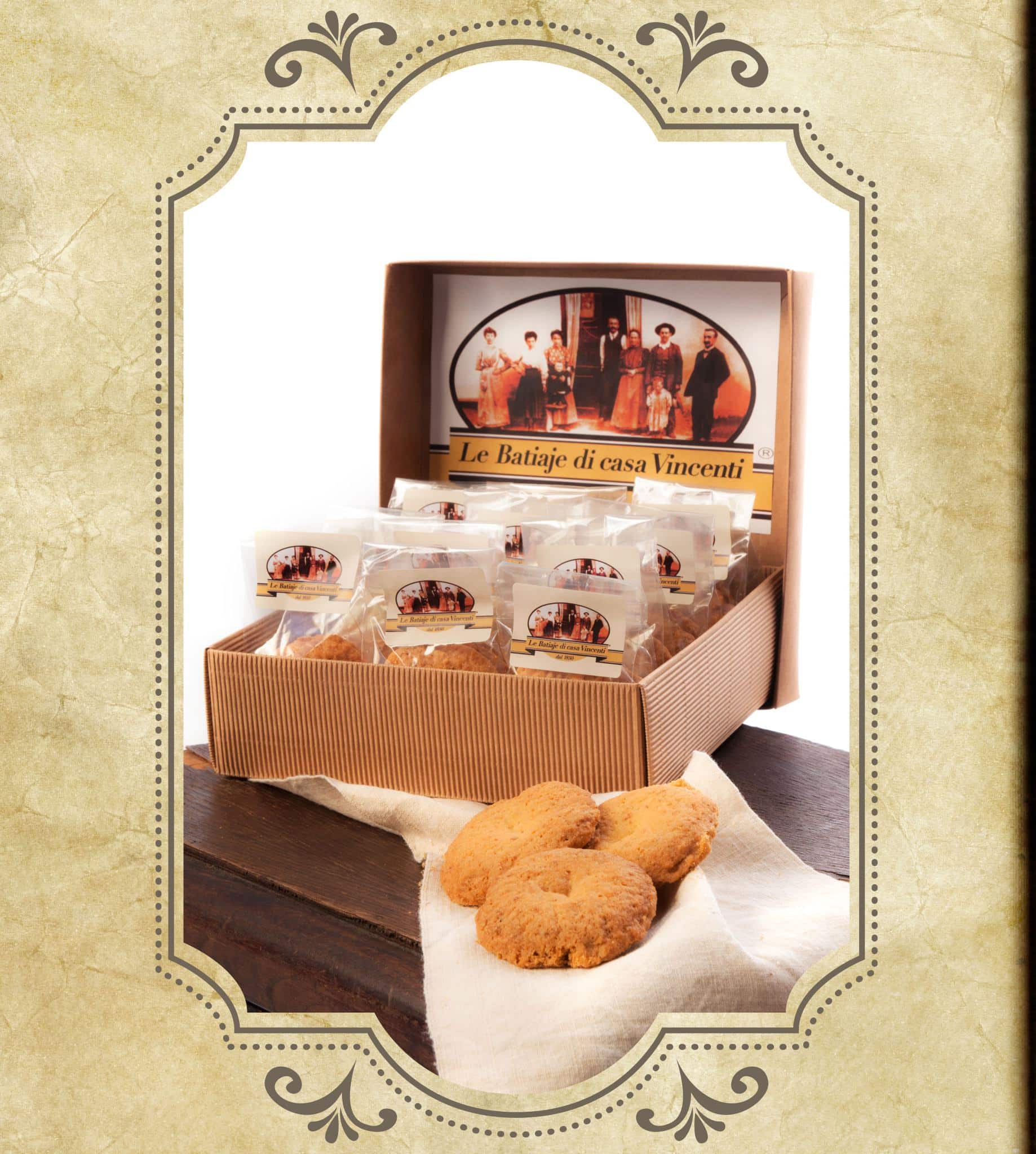
Casa Vincenti
What is it that makes Casa Vincenti's Batiaje so good? A secret ingredient, or that aura of mystery that surrounds them? When the time came for her parents to retire, Mirella Borda Bossana never imagined she would end up kneading dough and baking biscuits. And we're not talking about just any biscuits... but perhaps the most famous Batiaje in history, the ones once made in a Royal Household, whose recipe was stolen away by a young maid from Villar Bagnolo, a certain Miss Bosio. In short... Mirella, together with her husband Mauro, fortunately let herself be won over and drawn in, deciding to carry on the production of Casa Vincenti's Batiaje. And as she delved deeper into this new work of hers, Mirella came to realize just how fortunate and beautiful it was to be able to carry forward a tradition so rich in values, historical ones too. And then, so much passion—visible sparkling in her eyes—did the rest... A passion so intense that her son Francesco clearly felt it too, deciding to get involved in the family business. The Vincenti family of Barge's tradition now spans six generations. The young maid was in fact Mirella's great-great-grandmother, and going back to 1850, when the first Vincenti-named batiaje were made, it has now been more than 170 years that these delicious biscuits have been baked in Barge. But what makes them so good? According to the recipe, a generous amount of corn flour is needed—at least 40%—along with genuine butter and, of course, secret natural flavorings. And the ingredients from back then remain the same today. The dough is now mixed with a mixer, but the whole process is still done by hand, and the batiaje are prepared one by one, entirely by hand. Today these treats are known not only by the people of Barge but in many other places, even abroad. In fact, the family takes part in fairs and festivals, just as they did in the past. Back then, they would sell them carrying the "cabassa" (a wicker basket) and the "galliota" (a wheelbarrow), and it was very hard, tiring work. But this family's strength has shown itself time and again whenever needed, such as when Miss Bosio passed away suddenly at a very young age, and her fourteen-year-old daughter Giuseppina, on the very day of her mother's death, kneaded her first batiaje so as not to let the butter that had just arrived go to waste. For those unfamiliar with the term, "batiaje" in the Piedmontese language refers to the typical round biscuit made with corn flour ("meliga"), and its origin lies in a local tradition already in use more than a century ago: when bringing a baby to be baptized—always a great celebration—people would cheerfully say "Anduma a batiajè," meaning "Let's go and baptize," and these special biscuits were made to celebrate the occasion. The company proudly holds the Eccellenza Artigiana Piemonte trademark. In addition to the classic Batiaje, versions are now also offered with chocolate chips, chopped hazelnuts, and, depending on the season, with apples, strawberries, blueberries, and even with Pignoletto flour, an ancient Piedmontese corn variety. Another niche product are the amaretti: uniquely fragrant, handmade with top-quality ingredients, deliciously flavorful with a soft heart. Also in keeping with Casa Vincenti's tradition, at Christmas time they prepare the Panettone basso Torinese, a true delight, naturally leavened and topped with an almond-studded glaze, available both in its classic version and with chocolate. So, if you want something truly unique on your Christmas table, don't miss it..